1. Define Mudjacking & Polyjacking
To understand why these materials perform differently, it helps to understand what gets injected underneath your slab.
Mudjacking (Traditional Method): A heavy mixture of topsoil, sand, cement, and water is pumped under the concrete through large access holes. The physical volume of this wet slurry mechanically pushes the heavy slab upward.
Polyurethane Injection (Polyjacking): High-density expanded foam is injected as a two-part liquid polymer through tiny ports. A chemical reaction causes the liquid to expand by up to 40 times its original volume in seconds, expanding into small voids, compacting loose soil, and lifting the heavy concrete slab with remarkable precision.
2. Head-to-Head Comparison
| Feature | Mudjacking | Polyurethane Foam |
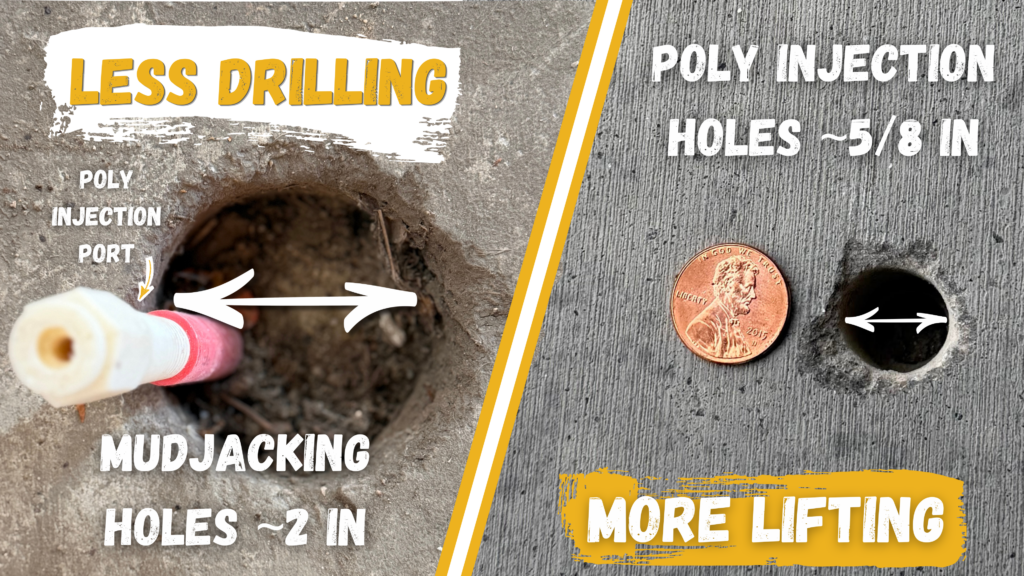
| Drill Hole Size | Large (1.5″ – 2″ diameter) | Penny sized (~5/8″) |
| Material Weight | Heavy (100–120lbs per cu. ft.) | Lightweight (3–4 lbs per cu. ft.) |
| Cure Time | 24–72 hours | 15–30 minutes |
| Water Resistance | Can erode/wash away | 100% Waterproof & Hydrophobic |
| Lifespan | 2–5 years | Decades / Lifetime of the slab |
3. Key Decision Factors Explained
Drill Hole Sizes & Aesthetic Impact
Mudjacking: Requires drilling holes roughly the size of a soda can lid (1.5 – 2 in wide) throughout your concrete. Even after being patched with mortar, these large circles leave obvious spots across driveways and decorative patios.
Polyjacking: Requires tiny drill holes about the size of a dime ($5/8$-inch). Much less discrete than the larger concrete scars left by mudjacking.
Material Weight & Soil Load
The primary cause of concrete settling in the first place is unstable or shifting soil.
Adding mudjacking slurry places 100+ pounds per cubic foot of added stress onto already weak subsoil. Over time, that massive weight can cause the soil underneath to compress even further, leading to re-sinking.
Polyurethane foam weighs only 3-4 pounds per cubic foot. It lifts thousands of pounds of concrete without burdening the soil below, effectively bridging voids without adding extra stress.
Moisture & Longevity
Colorado’s intense freeze-thaw cycles and seasonal runoff pose major challenges for concrete maintenance.
Mudjacking slurry consists of organic matter and cement, making it susceptible to water erosion. Over a few winters, moisture can seep beneath the slab, freeze, break down the mudjacking mixture, and wash it away.
Polyurethane is hydrophobic—it repels water completely. It never erodes, dissolves, or breaks down underground, ensuring a permanent lift that withstands heavy winter freeze-thaw cycles.
Cure Time & Convenience
Mudjacking: Takes days to fully dry and harden. You’ll need to keep cars off the driveway and avoid walking on patios for up to 72 hours.
Polyjacking: Expands and cures in under 30 minutes. You can walk and drive heavy vehicles across your concrete almost immediately after installation.
The Verdict: Which Is Better?
Polyurethane foam injection is overwhelmingly the superior long-term investment. Its light weight, imperceptible hole sizes, waterproof characteristics, and rapid cure times make it the modern standard for concrete restoration.
Get the Best Concrete Leveling in Colorado
When it comes to protecting your home’s concrete surfaces, precision and technique matter just as much as quality materials.
At Colorado Concrete Leveling, we bring over 50 years of combined experience to every project as the highest-rated locally owned and operated concrete repair specialist in the state.
We don’t rely on outdated mudjacking methods. We utilize the best concrete leveling technology available, installed exclusively by polyurethane-installation certified technicians.
Fully Insured & Locally Owned
Eco-Friendly, High-Density Foam Technology
Industry-Best Warranty Protection
Whether you need a sunken driveway raised, a tilting porch stabilized, or sidewalk trip hazards eliminated, trust Colorado’s leading local team to do it right the first time.